
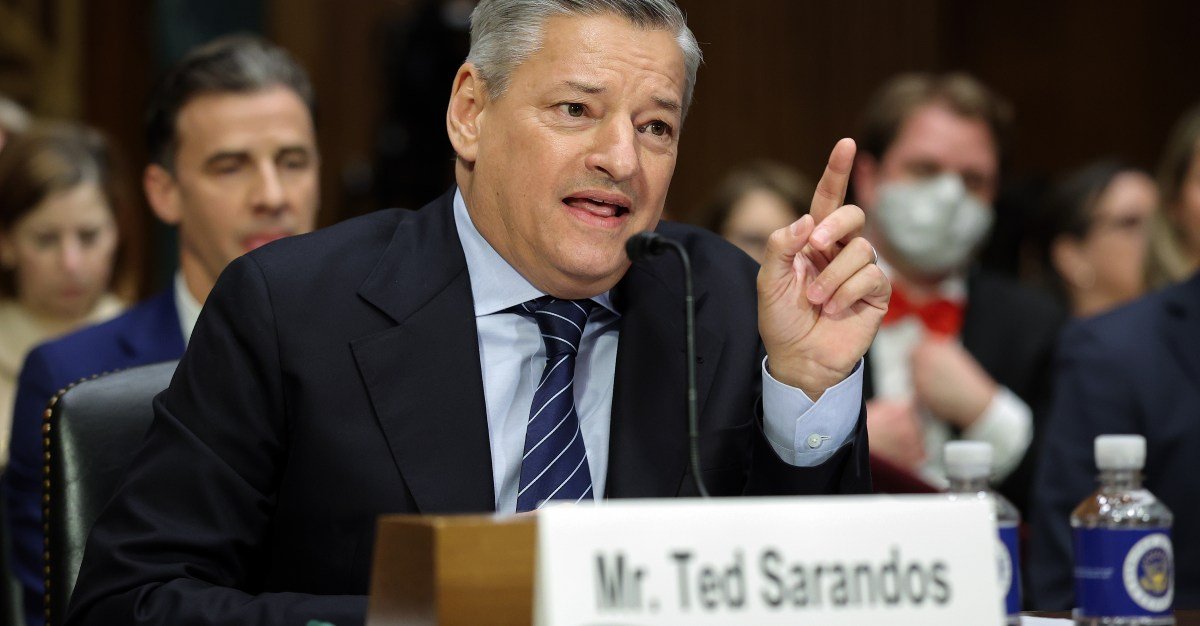
When Ted Sarandos, the CEO of Netflix, walked into the Senate Administration Building on Tuesday, he got a curveball. What began as a standard antitrust hearing related to the Warner Bros. merger quickly degenerated into a performative Republican attack on the streaming service’s spread of “woke” ideology. At the same time, an arguably far more influential platform was completely ignored: YouTube.
After going after Sarandos about the residual payments, Sen. Josh Hawley (R-MO) launched into an entirely different line of questioning: “Why does so much of Netflix’s children’s content promote transgender ideology?” Hawley asked, with the unsubstantiated claim that “nearly half” of the platform’s content for children contains so-called “transgender ideology.” The statement follows a pressure campaign launched by Elon Musk months ago in which he urged X users to unsubscribe from Netflix for having a “transgender woke agenda,” citing several shows with trans characters — shows that were canceled years ago.
“Our business is to entertain the world,” Sarandos replied. “It’s not about having a political agenda.” Still, other Republican lawmakers, including Sens. Ashley Moody (R-FL) and Eric Schmitt (R-MO), piled up and brought the contribution that Netflix made after the murder of George Floyd, and the French film Prettywhich unleashed a right-wing storm years ago. Sen. Ted Cruz (R-TX) even asked Sarandos what he thought of Billie Eilish’s “nobody’s illegal on stolen land” comment at the Grammys. They seemed to be grasping at straws to support their narrative that Netflix’s acquisition of Warner Bros. could somehow poison good content for viewers.
“I am concerned that you do not share my values or the values of many other American parents and want the United States government to allow you to become one of the largest — if not the largest — streaming monopoly in the world,” Hawley said. “I think we should be interested in what content you’re promoting.”
While it’s true that Netflix will control a significant portion of the streaming market when — or if — it acquires Warner Bros. and its HBO Max streaming service, it’s hard to criticize Netflix without mentioning YouTube.
“YouTube isn’t just cat videos anymore. YouTube is TV.”
Netflix has been trying to topple YouTube as the most watched streaming service for years. Nielsen data says Netflix accounted for 9 percent of total TV and streaming viewership in the U.S. in December 2025, while Warner Bros. Discovery accounted for 1.4 percent. The combination of the two is no match for YouTube, which had a 12.7 percent viewership share at the time. “YouTube isn’t just about cat videos anymore,” Sarandos told the subcommittee. “YouTube is TV.”
Unlike Netflix, YouTube is free and has an ever-growing library of user-generated content that doesn’t require it to spend billions of dollars on production costs and licensing fees. YouTube doesn’t have to worry about keeping subscribers because anyone with access to a web browser or phone can open and watch YouTube. This setup gives YouTube a steady stream of viewers that it can reach with plenty of content that it can recommend to watch.
But not all authors on YouTube strive for quality. As my colleague Mia Sato has written , YouTube is home to creators trying to feed an algorithm that favors outrageous content and tries to engage viewers, in addition to a number of videos that may be less than ideal for children.
Like it or not, YouTube is the dominant streamer, with an endless supply of potentially offensive programming for just about anyone. But for some reason that is not the goal of this culture war. If these lawmakers really care about what their kids watch, maybe they’d start looking more closely at how YouTube prioritizes content. Or, if they don’t like the shows and movies on Netflix, they could just do what Sarandos suggested during the hearing: opt out.