
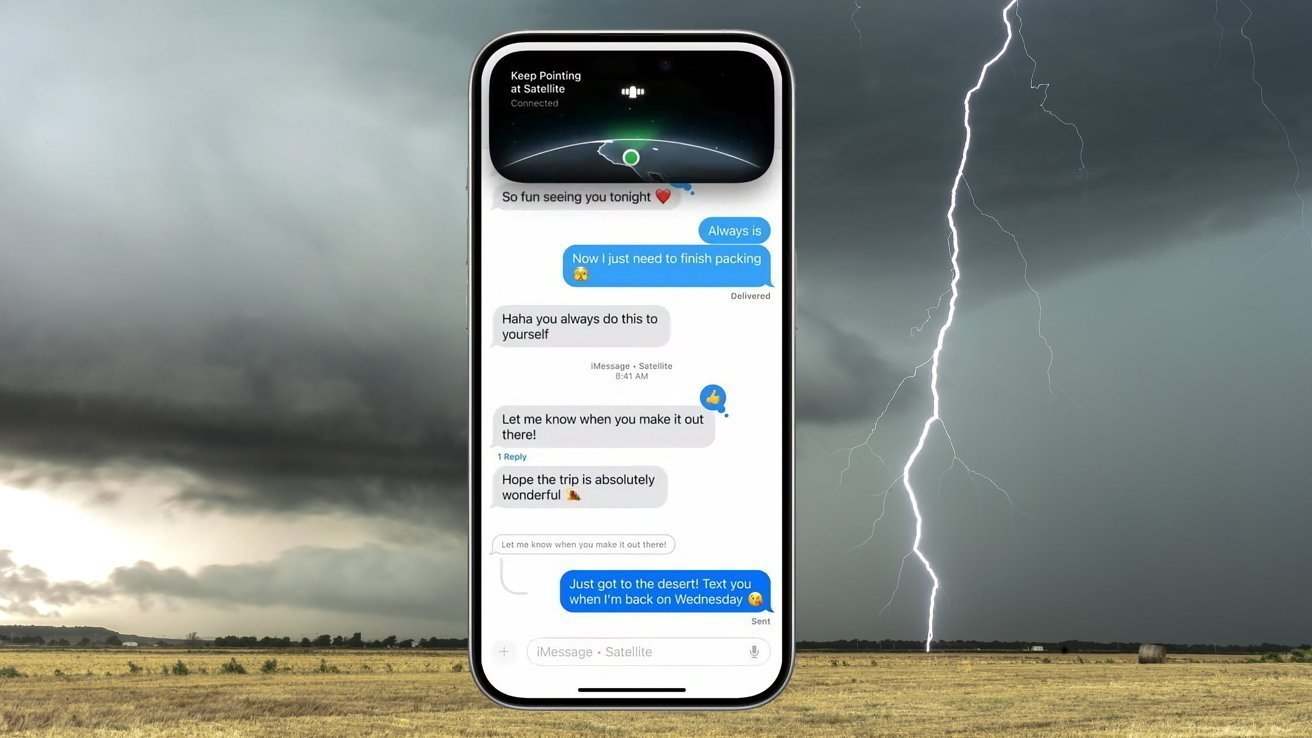
Apple’s satellite connectivity in future iPhone models will bring full 5G services almost everywhere you go. Here’s how and when to expect it.
The iPhone has some built-in features that allow it to be used in a signal black spot, especially in an emergency. While features like Emergency SOS Via Satellite are limited in what they can currently do, the connectivity change could reportedly make it even more useful for users.
According to a Wednesday post by Weibo provider “Fixed Focus Digital,” Apple will include support for NR-NTN (New Radio for Non-Terrestrial Networks) in its next C2 modem. The leak believes this will happen soon, with support added later in 2026.
NR-NTN is a technology that can be used for satellite connectivity beyond the current system. Rather than being a low-bandwidth service, it can be used for a 5G signal, potentially enabling calls and other high-bandwidth uses.
In fact, it could be used to provide 5G signal coverage in areas not covered by traditional telephone masts but visible to satellites.
This support will follow Huawei’s public testing of similar features at the end of 2025. While progress in China is clearly slower than the rest of the world, the leaker believes that Apple’s inclusion of features will be good news for the market and could spark wider adoption by other manufacturers.
Weibo leakers don’t have the best reputation for accuracy, with a tendency to repeat rumors from elsewhere without much fact-checking. Fixed Focus Digital is one of the most notable leaks, but still has mixed results.
However, this post is supported by rumors that have surfaced in the past.
The Internet from Orbit
In November, the more reliable Mark Gurman wrote about Apple’s work to improve the iPhone’s satellite-centric capabilities. This list of features included 5G NTN support to increase the device’s coverage areas.
Using the new technology means providing more bandwidth and signal strength than is currently available to iPhone users. This could be applied in many ways.
For starters, it’s possible that future iPhones will be able to establish a connection with a satellite in the user’s pocket, rather than aiming at the sky manually. For users, this would mean continuous messaging and updates without having to manually establish a connection.
The significant increase in bandwidth also means that users will have an experience closer to using a cellular network, instead of the hyper-limited messaging of current features. It doesn’t necessarily have to do with enabling video calling, but it could allow other apps to be updated more regularly.
Apple is also rumored to be working on an API for app developers to use for satellite communications. If created, it will expand the capabilities of satellite services to applications from third-party developers.
In terms of hardware support, this connectivity expansion will likely be primarily for devices using the C2 modem. This would mean at least the incoming iPhone 18 generation from Apple, with little chance of it being adopted by earlier generations.