
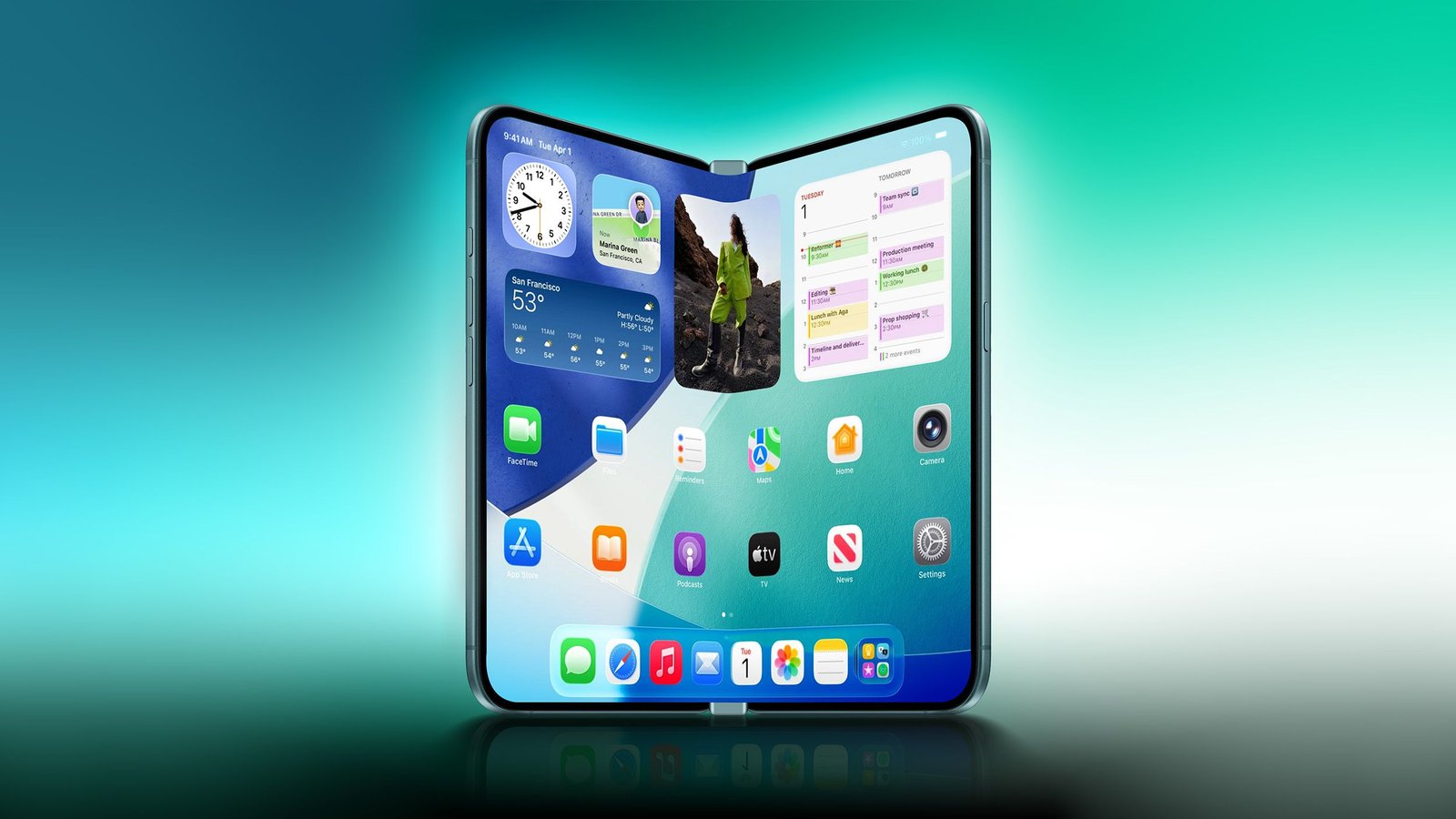
Apple is expected to launch a new foldable iPhone this year based on many rumors and trusted sources. The long-awaited device has been rumored for years, but signs are increasingly pointing to Apple launching its first foldable device in 2026.
Below, we’ve collected an updated set of key details that have been leaked so far about Apple’s foldable iPhone. Apple will reportedly call the device the “iPhone Fold,” a name the media has already adopted when sharing rumors about the product.
Overall design
Book style
According to BloombergMark Gurman, Apple’s foldable iPhone is similar in style to the Samsung Galaxy Z Fold, which uses a book-style folding mechanism rather than the clamshell design of the Samsung Galaxy Z Flip. Industry analyst Ming-Chi Kuo expects the foldable iPhone to measure 9 to 9.5 mm when folded and around 4.5 to 4.8 mm when unfolded. Recently, Weibo-based Instant Digital reported that the foldable iPhone will be at least 4.8mm thick. The leak also claimed that the volume buttons will be located on the top edge of the device, aligned to the right, similar to the iPad mini, while the power button and camera controls continue to be located on the right edge of the device, like other recent iPhones. The left rear of the device is also said to feature an iPhone Air-style camera tray.
Display
Dual screens
When folded, users will be dealing with a 5.5-inch external display similar to a typical iPhone screen, while unfolding reveals a larger 7.8-inch iPad-style screen. These dimensions have been confirmed by two reputable sources. However, a more recent report from Information claims that the device will have a 5.3-inch front display and a 7.7-inch internal display. According to one rumor, the inner foldable display will be about the size of an A6 piece of paper and use a resolution of 2713 x 1920, while the outer display will use a resolution of 2088 x 1422. Apple is said to be evaluating a tougher foldable display film technology, using a transparent polyimide film as a protective layer that would sit on the ultra-thin glass.
Wrinkle Visibility
‘No creases’
According to analyst Ming-Chi Kuo, the internal display is virtually wrinkle-free, thanks to Apple’s use of a metal plate that can dissipate and control the stress generated by bending the display. Apple is said to use liquid metal in the hinges to improve durability and help eliminate screen creases. According to the analyst, Apple chose liquid metal, made by a die-casting process, to solve this common problem with foldable devices. With reference to supply chain sources, China site UDN says that Apple has solved the “creasing problem” that plagued most foldable smartphones, and the foldable iPhone will be the first wrinkle-free foldable smartphone on the market.
Undercarriage and suspension
Sustainable materials
According to analyst Ming-Chi Kuo, the foldable iPhone is said to have a titanium chassis, with the hinge made of a combination of titanium and stainless steel. The frame itself will use a titanium alloy to avoid bending issues – a solution that’s been proven for Apple’s new ultra-thin iPhone Air. However, analyst Jeff Pu believes that Apple is using aluminum and titanium, while Kuo believes that a mix of stainless steel and titanium was chosen.
Cameras
Front and back
The foldable iPhone is expected to feature a dual-lens rear camera and a front-facing camera for both folded and unfolded states, according to Kuo. BloombergMark Gurman recently confirmed reports that the device will have four cameras consisting of one front camera, one interior camera and two rear cameras. Prolific Weibo based leaker Digital Chat Station claims that the rear dual lenses will be 48 megapixels each. Other sources have claimed that the inner display includes an under-screen camera (USC), while the outer display – when the device is folded – will have a punch-hole camera. More recent news from Information claims that the camera of the external display will be located in the upper left corner of the screen.
Authentication
Touch ID
Kuo believes the phone will ditch Face ID authentication and instead use a side Touch ID button as a means of saving valuable internal space, and Bloomberg’s Mark Gurman recently confirmed the rumor. Apple has previously integrated Touch ID into the side button of the iPad, iPad Air and iPad mini.
Mobile connectivity
Modem C2
The foldable iPhone will use Apple’s second-generation C2 modem for cellular connectivity Bloombergis Mark Gurman. Apple introduced its own C1 modem in the iPhone 16e last year, followed by the C1X in the iPhone Air, as part of a multi-year transition plan from Qualcomm modems. Gurman says the foldable device won’t have a physical SIM slot.
Battery life
High density cells
The device is said to be equipped with the largest battery ever used in an iPhone. According to a Korean blog that previously leaked exact details about the yet-to-be-released products, Apple is also very focused on improving energy efficiency by slimming down key components like the display driver to make room for more battery cells. The phone will reportedly use high-density battery cells. Expect the C2 modem to be faster overall and to gain mmWave support in the United States. Further improvements in energy efficiency are likely.
Color options
Black and white
Apple is currently only testing black and white variants of the foldable phone, according to suppliers Bloomberg‘s Mark Gurman, though he says Apple’s plans could evolve before the device launches.
Prices
Premium segment
Several reports have suggested that the foldable iPhone will cost between $2,000 and $2,500 in the United States, which could make it the most expensive iPhone ever. Meanwhile, analysts at investment banking firm UBS and Fubon Research believe the phone will be priced either between $1,800 and $2,000 or around $2,399, respectively. However, Kuo recently claimed that the hinge is expected to have an average selling price (ASP) of around $70 to $80 when mass production begins – well below market expectations of $100 to $120 or higher. Kuo attributed the cost drop to “assembly design optimization” and Foxconn’s influence in scaling production. Whether the hinge price cut will lower the retail price or simply boost Apple’s margins is an open question. Regardless of the price, the foldable device is expected to appeal to Apple’s loyal fanbase, some of whom will consider it a “must-have device” if its quality lives up to expectations.
Launch date
End of 2026
According to industry analyst Jeff Pu, the device entered Foxconn’s new product introduction (NPI) phase in March 2025, while a November report from a Chinese website UDN announced that the device has entered the technical verification phase and Apple is preparing for mass production. Foxconn is expected to officially begin manufacturing Apple’s foldable iPhone at the beginning of the fourth quarter (October), and a recent report suggests that Apple is already stockpiling components for pre-production. The exact launch date is currently unknown, but both Kuo and Pu say series production is planned for the second half of 2026. Bloomberg reporter Mark Gurman said he expects the device to launch this fall. However, Japanese banking firm Mizuho Securities suggested that a delay to 2027 could still happen as Apple takes longer to decide on key design elements such as the hinge.