
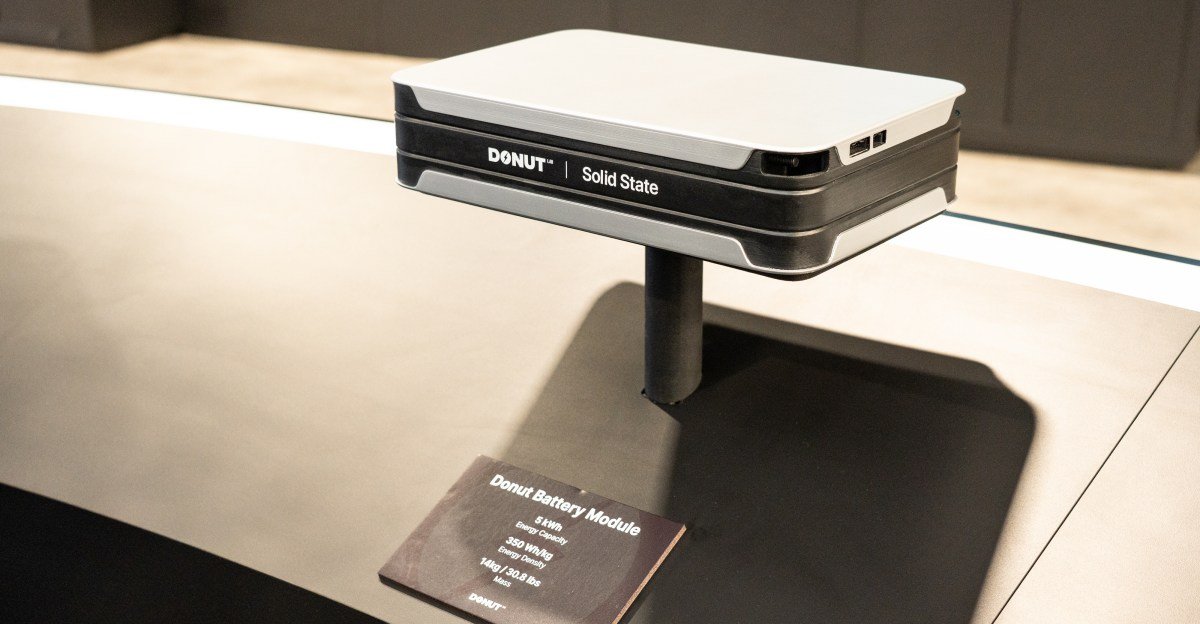
Ever since Finnish startup Donut Lab announced earlier this year that it was on the cusp of a major battery breakthrough, it has faced many questions and a lot of skepticism about its production-ready solid-state battery. Could the company actually mass-produce a fast-charging battery while avoiding some of the theoretical manufacturing issues that have plagued past efforts? Today, Donut Lab tried to dispel some doubts by releasing the first independent test of its battery, which evaluated its charging speed and the “thermal behavior” of its battery.
The test, conducted by Finland’s state-owned technical research center VTT, concluded that the battery can be charged significantly faster than a traditional lithium-ion battery. In several tests, the battery was able to charge from 0-80 percent in about 9.5 minutes while retaining 100 percent of its capacity. In other tests, 0-80 percent was achieved in around 4.5 minutes while retaining 99 percent capacity.
Often referred to as the “holy grail” of batteries, solid-state batteries have eluded researchers for decades. Most EV companies use “wet” lithium-ion batteries, which use liquid electrolytes to transfer energy. However, these batteries can be slow to charge, can freeze in sub-zero temperatures, and contain flammable material that can be dangerous in the event of a crash. Solid-state batteries are made of a “dry” conductive material that can hold more energy without any of the heat dissipation problems of traditional batteries.
Usually, if you force-charge a battery that fast, the chemistry immediately degrades and you lose capacity. According to these tests, the Donut Lab battery retained nearly 100 percent of its energy potential even after being drained of energy. This could turn charging an EV from a 30-40 minute stay into a 5 minute visit, similar to filling up at a gas station.
This could turn charging an EV from a 30-40 minute stay into a 5 minute visit, similar to filling up at a gas station.
Most battery EVs like Tesla or Hyundai have active cooling systems to keep the battery cool while charging. In this test, VTT removed everything with a passive cooling system to prove that the battery will not require a heavy and expensive liquid cooling system to charge safely. They did this in two different ways, first by sandwiching the battery between two pieces of aluminum and second by placing the battery on just one piece of metal—all while monitoring the temperature.
VTT used the “C-rate” measurement to describe how quickly a battery charges relative to its capacity, where 1C represents a charge from empty to full in one hour. Traditional lithium-ion batteries typically charge at 1C to 3C with active cooling, while in this measurement charging performance increases at significantly higher rates without active cooling. The VTT started with a standard discharge capacity test at 1C, followed by quick charge tests at 5C and 11C with both cooling configurations.
Under these conditions, the Donut Lab battery was successfully charged at 5°C for over nine minutes. At this charging performance, the battery cell reached an 80 percent state of charge in approximately 9.5 minutes and a full 100 percent charge in just over 12 minutes. When discharged after charging, 100 percent of the charged capacity was available from the cell.
There were some hiccups. During one test with only one cooling plate, the battery got so hot that it reached the safety limit of 90°C and the machine automatically shut down to avoid damage. The researchers realized that the battery was not touching the cooling plate tightly enough, so they attached it to improve thermal contact and allow the heat to escape to the metal more efficiently.
“Unlike other solid-state batteries that require high compression pressures and undergo volume changes of up to 15-20% during charge cycles, the Donut battery does not require special compression or extensive cooling,” said Donut Lab CTO Ville Piippo in a statement. “This greatly simplifies the structure of battery packs and enables solutions that are cost-effective, efficient and superior to traditional lithium-ion batteries in terms of energy and power density.”
Donut Lab claims its battery delivers 400 watt hours per kilogram. By comparison, most lithium-ion batteries today range from 200 to 300 Wh/kg. The company also says the battery can charge in less than 10 minutes and last 100,000 cycles. Current lithium-ion batteries typically last 1,500 to 3,000 cycles. The “Solid State Battery V1” that VTT tested has a capacity of 26Ah and a nominal energy of 94Wh, according to the institute.
But before you pop the champagne, keep in mind that the report doesn’t address some key questions about Donut Lab’s solid-state battery. First, VTT does not confirm pack chemistry, but simply takes it at face value. Second, the test did not address what Rod contributor Tim Stevens mentions the “dendrite problem”, in which microscopic stalagmites growing from anode to cathode across a solid-state electrolyte can cause electrical short circuits. Perhaps Donut Labs will address this in the follow-up independent test results it promises as part of its “I Donut Believe” series.