
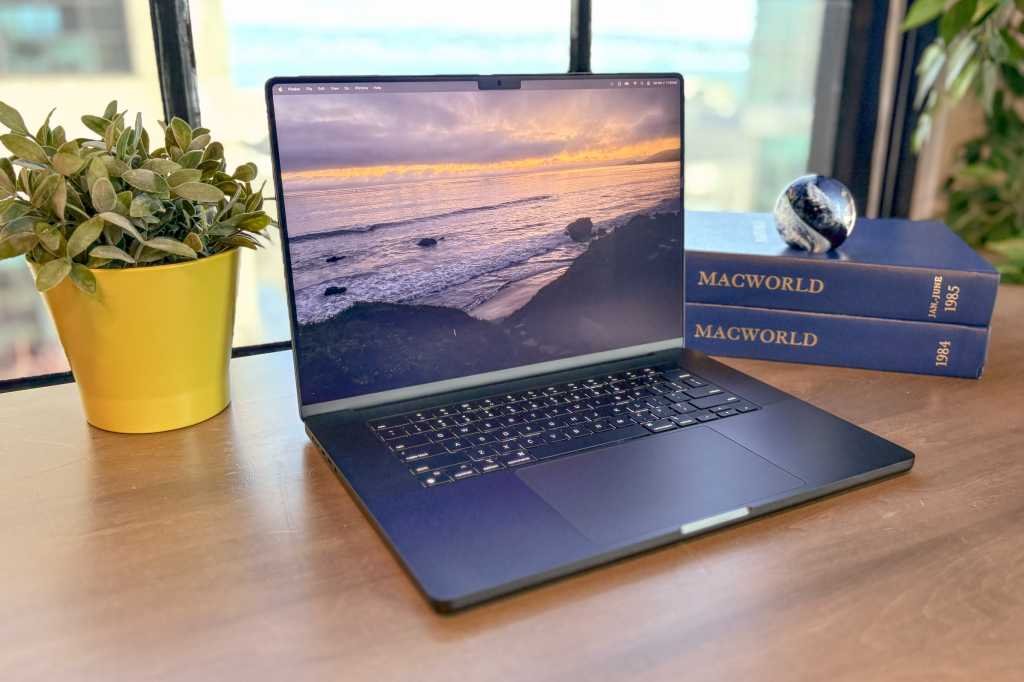
New M5 Pro/Max MacBook Pro: Camera
The M4 MacBook Pro added a 12MP FaceTime camera, a decent upgrade from the 1080p FaceTime camera. The M5 Macook Pro maintains this camera, so it’s unlikely that the Pro and Max models will get anything.
However, we could see a similar update to the FaceTime camera to 18MP as on the iPhone 17. The square sensor is less relevant here as the MacBook Pro will only ever be in one orientation, although it could allow more of the area around the person to be visible.
Rumor has it that there will be more changes to the camera in the M6 generation: reports suggest that in the future we may see a punch-hole webcam instead of a notch.
Petter Ahrnstedt
The New M5 Pro/Max MacBook Pro: Processor and Performance Expectations
- The new chip design for the M5 Pro and M5 Max could house the CPU and GPU on separate blocks.
The M5 MacBook Pro, which launched in October 2025, was little more than a chip refresh for the consumer version of the machine. The Pro and Max chip variants are aimed at professionals whose workflows require consistently high performance that exceeds the capabilities of standard M5 or M4 chips.
The M5 Pro and M5 Max chips are expected to be significant upgrades over the M4 Pro and M4 Max, and will likely be designed to push the boundaries of Apple Silicon by increasing the number of cores and memory interfaces. For each generation of Pro silicon made by Apple, it supports more CPUs and more GPUs, more memory, and additional ports such as Thunderbolt 5 that are not yet supported at the entry level.
M5 Pro and M5 Max chips: Alleged features and specifications
The M5 Pro and M5 Max chips are expected to represent a significant architectural departure from previous generations, specifically designed to handle the growing demands of artificial intelligence and parallel processing.
The most significant rumor surrounding these high-end chips involves a fundamental change in how they are constructed. In October 2025, MaxTech’s Vadim Yuryev reported that Apple was working on a new chip design for the M5 Pro and M5 Max that would feature the CPU and GPU on separate blocks.
This modular chip design could allow for more flexible CPU/GPU configurations and give customers more configuration options for these components. For example, it would be possible to set a basic CPU configuration with maximum GPU. Yuryev stated that this new design is the reason why the M5 Pro and M5 Max have been delayed until 2026.
This “SoIC-MH” manufacturing process is said to allow Apple to vertically stack semiconductor chips, which is expected to provide superior thermal control and performance compared to the standard 3nm process used in the base M5. These high-end chips are housed in 14-inch and 16-inch chassis that use a dual-fan cooling system, while the entry-level M5 MacBook Pro relies on a single-fan design that has been noted to heat up under heavy load.
Although the exact number of cores for the M5 Pro and Max has not been officially confirmed, they are expected to be significantly higher than the base M5’s 10-core CPU and 10-core GPU configurations.
- Process technology: TSMC’s third generation 3nm process (N3P), offering roughly 10% better efficiency and 5% faster speed than the M4 series.
- Memory bandwidth: Expected to follow the ~30% increase seen in the base M5, potentially achieving significantly higher throughput than the M4 Pro/Max.
- GPU capabilities: Likely to include third-gen hardware-accelerated ray tracing and second-gen dynamic caching.
- Connectivity: Confirmed support for Thunderbolt 5, providing video speeds of up to 120 Gb/s and data transfer of 80 Gb/s.
- AI performance: Said to include a “Neural Accelerator” in each GPU core, separate from the standard neural engine, to boost AI-based workloads.
Reports indicated that we can expect a typical performance increase from one chip generation to the next – between 15 and 25 percent over the M4 chips.
To summarize, key performance expectations include:
- Architectural Shifts: Reports suggest that these higher-end chips will feature separate CPU and GPU blocks, allowing for more flexible configurations, such as a base CPU paired with a maximum GPU for parallel processing for AI.
- Memory and storage: Following the trajectory of the M4 series, the M5 Pro is expected to support at least 48GB of RAM, while the M5 Max could support up to 128GB or more. The Max variant will likely continue to be the only option with support for up to 8TB of storage.
- AI and graphics: The M5 architecture, which shares core designs with the A19 Pro, is expected to deliver a “nearly 30 percent increase” in memory bandwidth (roughly 153GB/s for the base M5) and a fourfold increase in performance for GPU-based AI workloads. The M5 Pro and Max extend these gains even further for demanding professional tasks.