
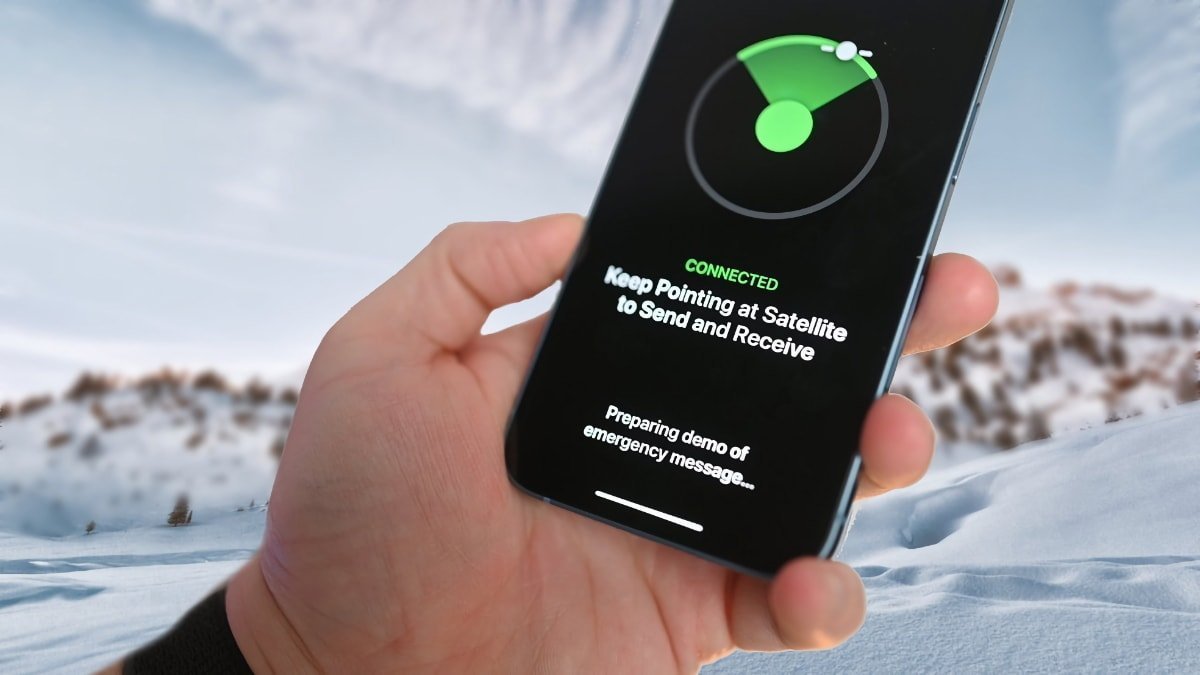
The Apple iPhone’s satellite capabilities may be growing, but physics is unforgiving. There’s still a limit to how much satellite Internet can do and how fast it can do it—unless Apple makes the case it’s been researching that doubles as a large antenna.
When Apple first launched Emergency SOS via satellite with the iPhone 14 in 2022, it was a remarkable idea that has since saved many lives. Apple has improved it since then and plans many more in the future, but there is always the problem of establishing satellite contact.
Users have to point their iPhone towards a satellite orbiting the Earth and then point at it continuously as the satellite moves relative to the sender. A single satellite in Low Earth Orbit (LEO) will go from horizon to horizon in seven minutes, but the connection time to the line of site is shorter than in real life and depends on buildings, trees and terrain.
iPhone software helps locate and track the satellite. The iPhone antenna still has a small area and is not as powerful. Only so much data can be reliably sent before the satellite moves away.
Now, in a newly revealed patent application originally filed in 2024, Apple has shown how it looked for a way around this. “Electronic Device and Case with Satellite Communication Capability” details ways to use the case, which acts as an antenna for the iPhone.
Specifically, it would be a phased array antenna. This means it has multiple receivers and transmitters. A major simplification of physics, with a phased array, instead of having to find a single satellite, it can connect to a whole group of them and shift as the constellation moves.
According to Apple’s designs, this case would be similar to a regular case in that it could be put on and taken off. In some schemes, it connects to the iPad via the Smart Connector for power.
“The removable case may contain a phased antenna array within the housing,” says Apple. “In the open position, the housing may direct the phased antenna array skyward (and the removable housing may contain beamforming circuitry within the housing and coupled to the phased antenna array.”
A detail from a patent application showing one possible flip case design — image credit: Apple
Apple says the iPhone could “transmit wireless data with a removable case via a high-frequency connector” or various options such as NFC (Near Field Communications). The case could then pass the data back in the same way.
This could also solve a problem with its current solutions that Apple specifically points out.
“While the cover is in the open position,” the patent application states, “the phased antenna array can transmit wireless data to the satellite over the signal beam without being blocked by the user’s hand while the user is holding the device and the removable case.”
Giving the iPhone a bigger satellite dish means it would be possible to send more data than it can handle right now. First with the expectation that Apple eventually wants to offer full internet via satellite.
More data, but fewer users
This all sounds ideal, but building the antenna into the case creates problems. Right now, satellite functionality works for every iPhone user – when they can’t get a regular cellular signal, satellite is offered.
Currently, the user does not even need to know that something like satellite communication exists. Not until they need it and the iPhone prompts them.
A contingency antenna would require users to be aware of its existence and also predict that they might need it. There will be many users who do exactly this, but there will still be people who unexpectedly find themselves in danger.
So it’s ideal to have this function all in the iPhone instead of the case. But until, or unless, it becomes possible, we may eventually see a case that improves satellite communications.
At the moment, emergency SOS via satellite works whenever there is no mobile signal. But you can see how to use it before you go climbing.