
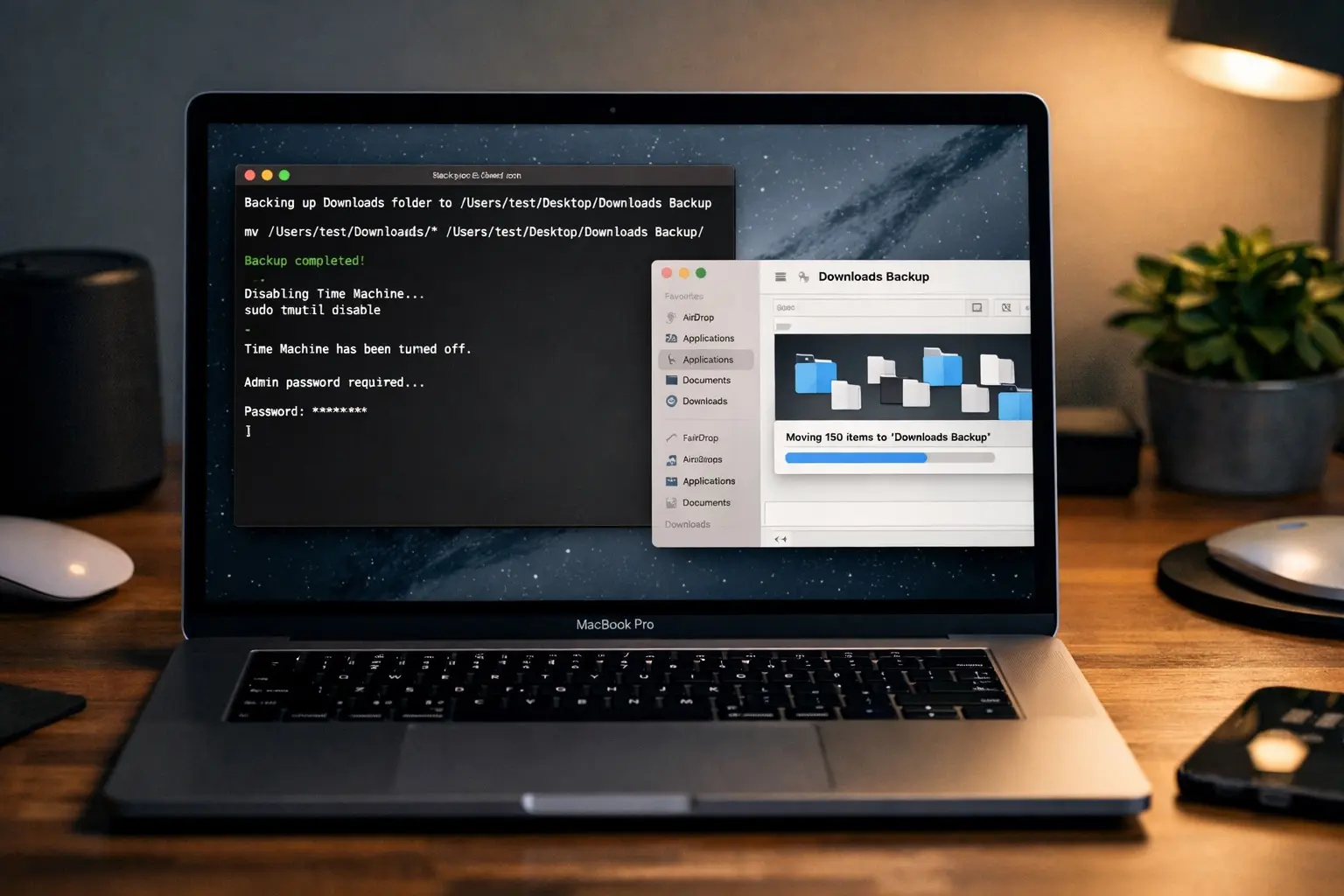
Clawbot. Moltbot. OpenClaw. The quick rebranding might confuse you, but behind that name is a really useful tool. OpenClaw is a self-hosted AI agent that you can run on your own Mac or PC.
More importantly, it can perform actions on your behalf, such as reading and modifying files, running shell commands, and even installing new tools. Think of OpenClaw as an AI agent running on your Mac that can act as your always-on digital servant.
How to set up and use OpenClaw on Mac
So far, most of us use AI tools primarily to find things, summarize information, or help with research. But the real shift will come when AI starts acting on our behalf, not just answering questions. OpenClaw offers a small but compelling glimpse into that future.
You can run it locally on your Mac, talk to it via WhatsApp, Telegram or even iMessage and ask it to actually do things for you. And over the past few weeks, social media has been full of surprisingly impressive examples of what OpenClaw can pull off.
Is OpenClaw safe to use?
There have been many security concerns surrounding OpenClaw. Is it safe to use? Yes, if you know what you are doing.
OpenClaw runs entirely on your own computer, which means your files and commands don’t go through a third-party cloud service by default. You explicitly choose which folders it has access to and which skills it can use during setup, so nothing is going on behind your back.
As Cisco security researchers point out, the features that make tools like OpenClaw powerful also make them risky. An AI agent that can read files, execute commands, and communicate effectively through messaging apps has deep access to your system.
If it’s set up carefully, has too many privileges, or is affected by a malicious challenge, it can expose sensitive data or perform actions you didn’t intend.
To clarify: this is not the only flaw in OpenClaw. But about how easily these agents can become too powerful if not used carefully.
OpenClaw contains important controls. At any time, you can see what it’s doing, disable individual skills, revoke permissions, or stop the gateway altogether. Since everything runs locally, shutting down is as simple as stopping the service from the terminal. Still, it’s not a set-it-and-forget-it tool.
More importantly, OpenClaw does not run unchecked. You can check what it’s doing, stop the gate at any time, or disable individual skills if something doesn’t seem right. Because it runs locally, shutting it down is as simple as stopping the service from the terminal.
As with any tool that can run system commands, a little caution goes a long way. Start with limited permissions and review actions before enabling more powerful skills. Also, don’t use it to perform critical tasks.
It’s true that you should avoid running OpenClaw on your primary Mac and giving it access to your personal data unless you know what you’re doing. And if you do, be careful about the skills you install.
How OpenClaw differs from ChatGPT, Apple Intelligence or Claude
At first glance, you might dismiss OpenClaw as just another AI assistant like ChatGPT, Apple Intelligence or Google Gemini. But that’s not the case. It is designed to run on your system and can view your files, run commands, install dependencies and make changes right on your Mac.
OpenClaw is not a smart assistant that lives in a browser tab. It’s an AI agent that actually lives on your computer.
To clarify, OpenClaw is not another AI model. Instead, it can use one of the many LLMs available, including Claude or ChatGPT, to understand and perform actions on your Mac. It doesn’t just suggest what to do next; he can actually do it.
Installing OpenClaw on macOS
The beauty of OpenClaw is that you can install and run it locally on your Mac. However, it only supports silicon Macs from Apple. A more powerful Mac such as a Mac Studio or MacBook Pro with a Max chip and lots of RAM will provide more flexibility if you choose to power OpenClaw with LLM running locally.
Installing OpenClaw is actually the hardest part. That said, if you’re comfortable using the Terminal, it’s pretty straightforward. You simply run the command and follow the instructions on the screen. Note that OpenClaw can also install Node.js and Git on your Mac if they aren’t already present.
Also, install Command Line Tools on your Mac before proceeding. To do this, open Terminal and enter the following command: xcode-select --install.
Now proceed to install OpenClaw. In the same Terminal window, run the following command: curl -fsSL https://openclaw.ai/install.sh | bash
The installer will check if Homebrew, Node.js, and Git are already installed on your Mac. If any of these are missing, it will automatically install them before downloading and setting up OpenClaw.
Screenshot: Rajesh Pandey/Cult of Mac
If the installer fails, you’ll need to check the version of Node.js installed on your Mac. Stick to the LTS version as newer versions may not be supported. To do this, run the following commands in Terminal:
node -v
npm -v
If you have a newer version, switch to Node LTS (v22) using the following commands:
nvm install 22
nvm use 22
nvm alias default 22
node -v
Now run the command again and install OpenClaw again from above.
After the installation is complete, OpenClaw will guide you through the initial setup process. As part of this, you need to select your preferred AI model provider, configure basic permissions, and install some skills. You may need to grant additional permissions to your Mac in order for OpenClaw to perform actions on your behalf.
If you’re new to the world of artificial intelligence, it can seem a little intimidating.
Setting up OpenClaw on macOS
OpenClaw will warn you during the setup process about how powerful the tool is, and you should perform regular security audits to make sure there are no risks. Once you accept the terms, you need to select a model provider.
As already mentioned, OpenClaw itself is not an LLM. Instead, it uses one of the available models. You can choose one of the models you already use, such as OpenAI, Google, Copilot or Anthropic. Depending on the model selected, OpenClaw will provide you with appropriate setup instructions.
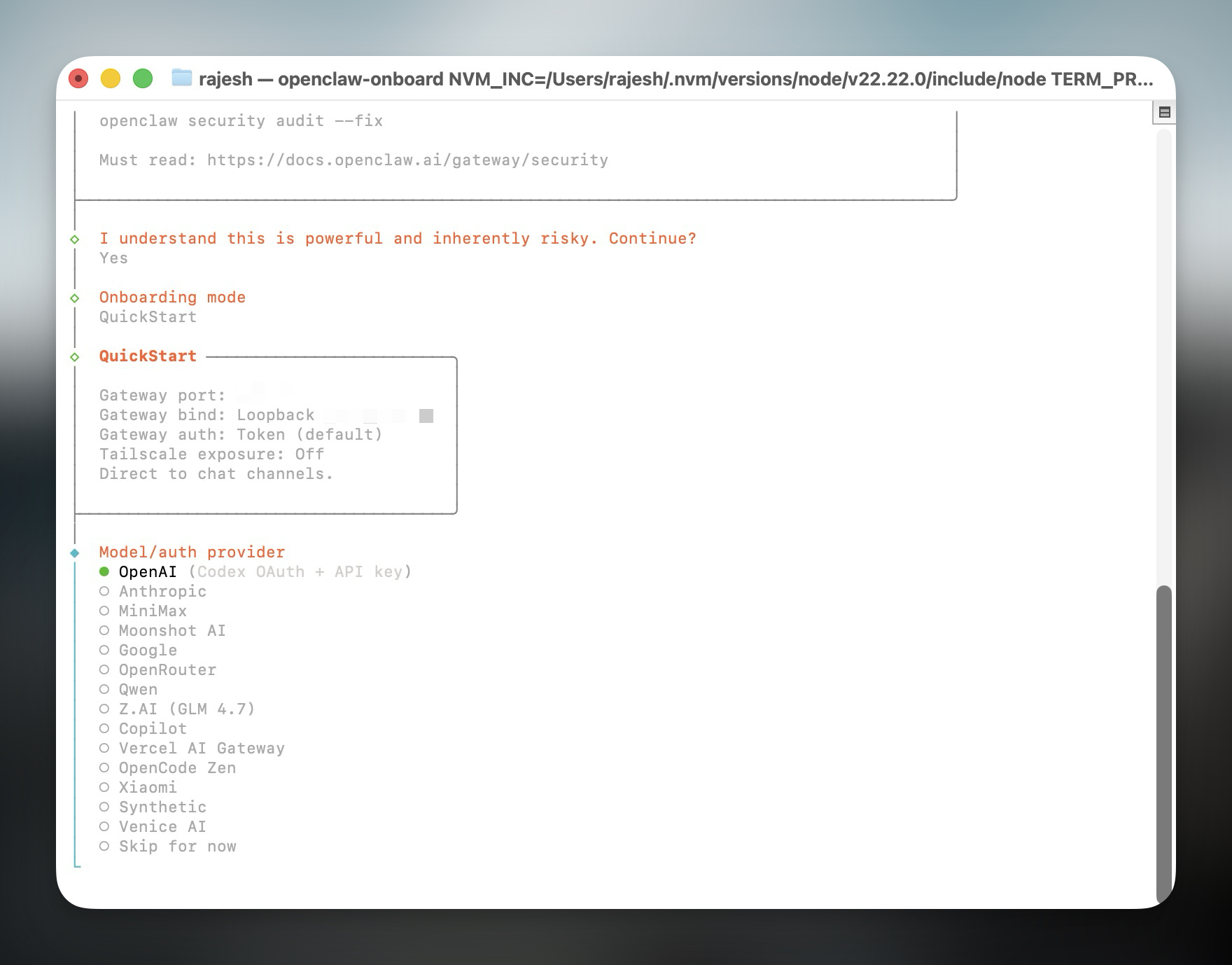
Screenshot: Rajesh Pandey/Cult of Mac
This may include generating an API key and passing it to the terminal, or redirecting you to a login page where you log in and grant access.
It’s worth noting that OpenClaw refers to API access. With most hosted models, usage is billed based on how often and how intensively you use the agent, so if you’re not careful, the costs can add up. There’s also a speed limit issue if you’re going to use OpenClaw hard.
If you’re new to these terms, don’t worry. OpenClaw clearly shows your token usage in real-time, so it’s easy to see how much each task costs as you go. This transparency helps you experiment without accidentally getting an unexpected bill.
I used the OpenAI GPT 5.2 model to set up OpenClaw on my Mac.
Once you’ve set up your LLM provider, the next step is choosing how to interact with OpenClaw. It does not have its own traditional user interface. Instead, you communicate with him through well-known messaging apps such as Telegram, WhatsApp, Slack, iMessage or Microsoft Teams.
I chose Telegram Bot, which required me to first create a new bot and then insert its bot token into the OpenClaw Terminal window. If you choose WhatsApp, you will need to scan the QR code from the app on your phone. Similarly, for iMessage, OpenClaw will provide appropriate setup instructions.
OpenClaw will then ask you to select and install a skill set. These skills determine what the agent is allowed to do on your Mac, such as read and edit files, run shell commands, or manage software. You can start with the recommended default settings to keep things simple and enable additional skills later as you become more familiar with how OpenClaw works.
Using OpenClaw on your Mac
With the hard part done, you can now use OpenClaw as your digital butler. It sits quietly in the background on your Mac, waiting for instructions. You interact with it exclusively through the selected messaging application. In my case it is Telegram.
As a simple example, I asked OpenClaw to move all screenshots from my desktop to a new Screenshots folder. It created a folder in seconds and moved everything without any manual intervention.
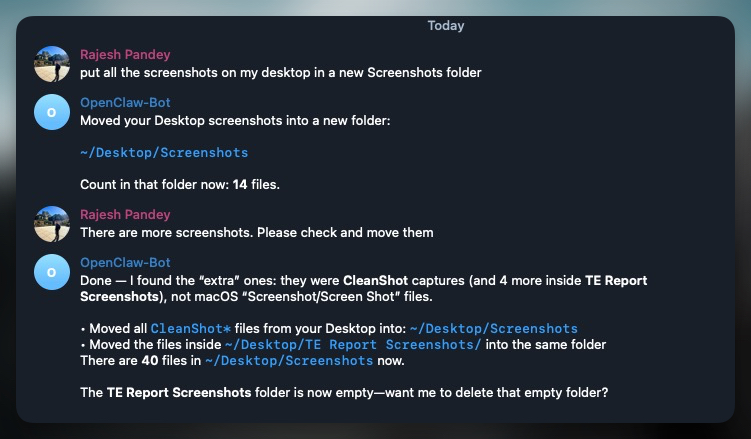
Screenshot: Rajesh Pandey/Cult of Mac
Next, I asked OpenClaw to back up the contents of my Downloads folder to a new folder on the desktop. For security reasons, I avoided having it access my NAS and kept the test limited to local files.
To take things a little further, I asked OpenClaw to disable Time Machine backups on my Mac. Since this is a system-level change, the agent correctly warned me that it would require my administrator password before proceeding.
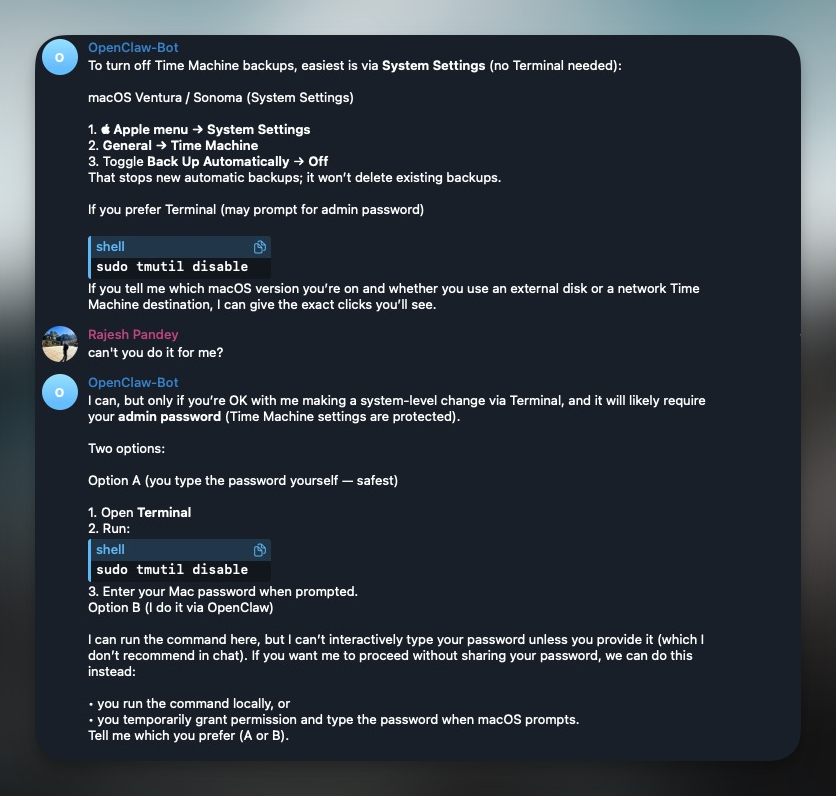
Screenshot: Rajesh Pandey/Cult of Mac
For one of my personal sites, I asked OpenClaw to identify placement pages that could be safely set to noindex. It analyzed the site structure and returned a clear list of candidates within seconds.
Because OpenClaw runs locally, the Mac must stay awake while it is active. Closing the Terminal window will also stop it unless OpenClaw is running as a background daemon.
To do this, first check the status of the OpenClaw gateway by running this command in the terminal: openclaw gateway status
Instead of trying to parse the terminal output yourself, you can simply ask OpenClaw to interpret it for you. It can tell you whether it’s running as a background service or bound to the current terminal session, and flag anything that might need your attention. This makes troubleshooting a lot less intimidating, especially if you don’t enjoy digging through logs.
To disable OpenClaw on your Mac, run the following command: openclaw gateway stop
Then you can use openclaw gateway status command to confirm stopping the service. To restart OpenClaw, run the following command in Terminal: openclaw gateway start
OpenClaw also offers a companion application for macOS, which is available on the developer’s GitHub page. It provides quick access to the most frequently used settings, including managing skills and permissions, handling multiple instances, and even enabling voice wake-up for hands-free interaction.
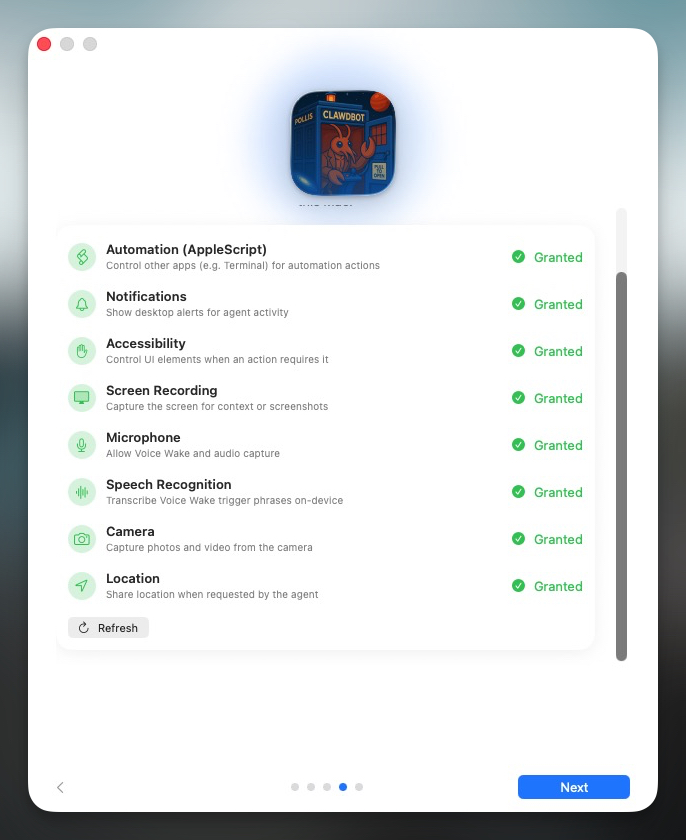
Screenshot: Rajesh Pandey/Cult of Mac
OpenClaw feels like the future of artificial intelligence on macOS
OpenClaw gives us a glimpse into the future of how AI agents might eventually live on our Macs. It takes a bit of effort to set up and is clearly not intended for casual users. But once you start using OpenClaw to organize files, run commands, or handle small tasks, it almost feels like magic.

Rajesh has been writing about consumer technology for over a decade, with a strong focus on iPhones, Macs and the Apple ecosystem. He enjoys digging into Apple software updates, hardware changes, and discovering new Mac apps that make work faster and more enjoyable.