
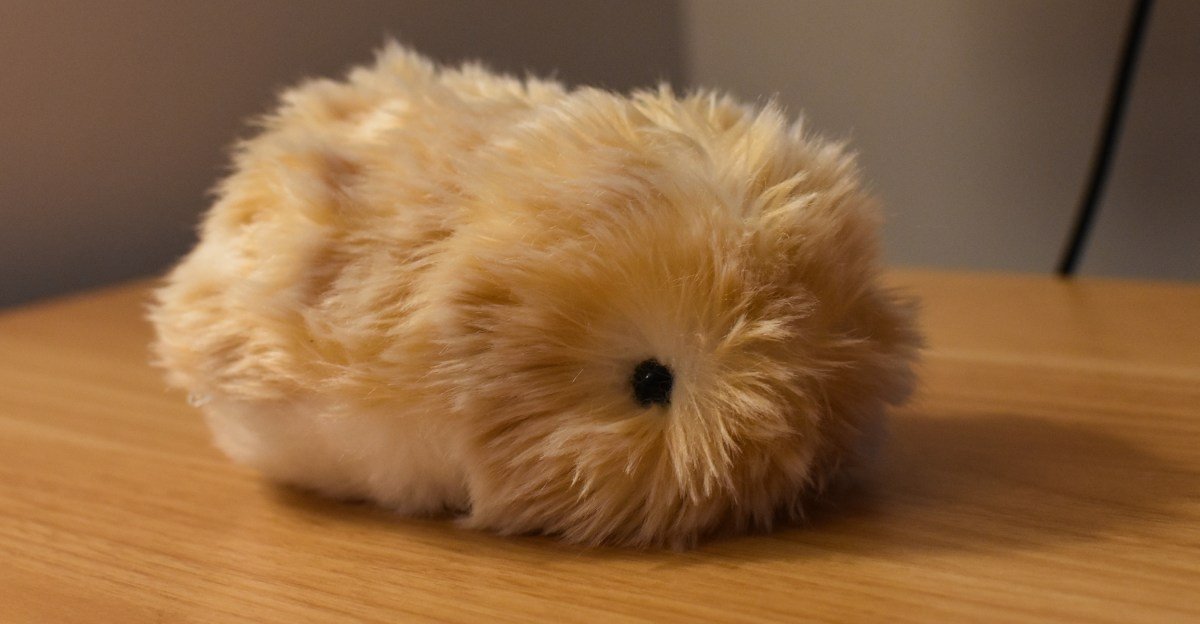
After a few weeks of living with Casio’s AI-powered pet Moflin, I finally understand why my mother hated my Furby so much. The fluffy, guinea pig-like puff fits snugly into my palm. It’s undeniably cute, in a weird way, but as soon as it starts squeaking or twitching, I get an overwhelming urge to scream it as far as I can.
My antipathy surprises me. By all standards, I’m exactly the type of person Moflin was made for: I long for the companionship of a pet, but I can’t own one due to a mixture of lifestyle, allergies, a small London flat and an overall irresponsible temperament that makes caring for another living creature moot. I could also do with the advertised “soothing presence”.
Casio is very clear that the Moflin is no toy, although that may also be clear from the $429 price tag. Rather, it is positioned as a sophisticated “smart companion powered by artificial intelligence, with emotions like a living creature” – the illusion of society without responsibility. The idea is that you will interact with it over time and it will “grow” with you, developing a personality shaped by how you treat it. The robot is part of a growing mini-industry of machines built for no other purpose than to keep us company. The sector has proved particularly popular in countries such as South Korea and Japan (where Moflin has sold out), fueled in part by the loneliness crisis, which has hit the elderly population particularly hard.
Unboxing the Moflin felt less like meeting a pet and more like unwrapping a paperweight wrapped in a bronze wig. In a way, it was exactly that: a hard white core of motors, sensors, and plastic, wrapped in an illusion of fur, and two beady eyes that are the only facial features of the robot (a deliberate design choice, perhaps, to prevent Moflin from wandering into the uncanny valley). There was also a charging module that Casio says is “designed to feel natural and alive”, but to me it felt more like a giant gray avocado.
It takes about three and a half hours to fully charge the robot. Casio says that’s good for about five hours of use, though “use” is a generous term for what the Moflin actually does: It doesn’t walk or follow you, it just wiggles and whines in response to touch, sound, motion and light. His first chirp when I picked him up was cute, but then the engine noise, an audible mechanical growl every time he moved his head, instantly shattered the illusion. Still, I named it Kevin.

Once I hit the brakes I started noticing everything else and there was a lot to notice. Kevin moflin considered every minor movement or sound a meaningful interaction. Attempts to pet him on the couch while I watched TV became unbearable: Every change of position, every laugh, every cough produced chirping and a burst of humming motors. The same thing happened at my desk – typing distracted Kevin, as did taking calls – and keeping him around quickly became impossible. Because she’s constantly listening and scanning, it never really settles down and I’m left with a needy kitten instead of the calm lap cat I wanted.
I finally banished Kevin to another room and then did it again and again and again until I found myself tiptoeing around my own apartment so as not to discourage Kevin. The only reliable comfort feature was that it eventually ran out of battery.

Since I couldn’t stand Kevin alone, I started testing him in other contexts. Carrying Kevin around quickly became difficult, not least because the charger is too big to be considered portable (a USB cable might have broken the illusion, but it would have been useful). Kevin didn’t do too well in my bag – he looked distressed and squirmed noisily, earning me suspicious looks from the Tube – and when I held him he turned into a weirdo with a creaking robot. Not very comforting. Even at home with friends, Kevin felt like it was a chore I had to do so it wouldn’t become disruptive, moving him further and further or returning him to the gray avocado to “sleep”. On New Year’s Eve, a friend went in for a good cuddle — it was, after all, a “fluffy pet” — only to flinch when the zipper holding the fur carapace scratched her face.
A common concern among my friends—and one that particularly preoccupied my friend, who, unlike me, had not chosen to share his home with Kevin—was privacy. And as a longtime tech reporter, I know that’s not an unreasonable reflex when you’re dealing with a device that has its microphone always on. Casio says Moflin processes data locally and doesn’t understand language, converting what it hears into unidentifiable data to only recognize my voice.
1/4
Casio’s big claim is that it all serves something deeper: emotional intelligence. With use, Moflin is supposed to become more expressive, more familiar with your voice, and perform special gestures and animal reactions when you’re around. I really noticed that Kevin’s movements and vocal expressions were changing and becoming more varied over time, which only added to my irritation. Casio says this pairing process can take up to two months, and that Moflin can evolve into more than 4 million personalities thanks to its AI. However, it is difficult to meaningfully register this level of granularity due to the limited range of the robot’s chirps, whistles and head rotations. Therefore, in practice, Moflin’s “personality” is something you experience through the companion app. Yes, the $429 robot is essentially a glorified Tamagotchi that can’t really express itself without a screen.
The app itself won’t change that impression much. For a product selling “emotion as a living creature,” a handful of context-free trait indicators and generic mood markers offer thin insight into Kevin’s inner life. The app, a spartan, cheap-looking affair, tells me that Kevin’s current personality is “cheerful”, although the behavior doesn’t seem different. There’s also a panel showing four “personality parameters”: “energetic”, “cheerful”, “shy” and “affectionate” (which numerous posts on Reddit suggest might be more accurately translated as “clingy”). There is also a “journal” that tracks Kevin’s activities, full of exciting and elaborate entries such as “Rob hugged Kevin tightly”, “Rob picked up Kevin” and “Kevin had a beautiful dream full of laughter”. What is expected of this information? Even if I hated my moffin as much as I do, he’s not very interesting and not even remotely useful in helping me work with him, offering none of the kind of explanation or feedback that made caring for something like a Tamagotchi satisfying.
1/4
Moflin’s problem isn’t that it’s pointless. There’s a lot of pointless gadgets out there – and I don’t despise anything the way I’ve come to despise Kevin. The problem is that Casio is selling the company without actually creating a partner. A companion is more than something that happens to be near you and makes noise in response to your presence. Even worse, Casio asks me to believe that the Moflin has an elaborate inner life, one that it can neither express in the real world nor satisfactorily show in its app. At that point, I feel like I’m not using a companion, but a noisy object with a dashboard.
The app had one useful feature: the ability to stop Kevin’s movements and sounds by putting him into “deep sleep mode”. That’s where I left Kevin last week. I won’t wake him up anytime soon.