
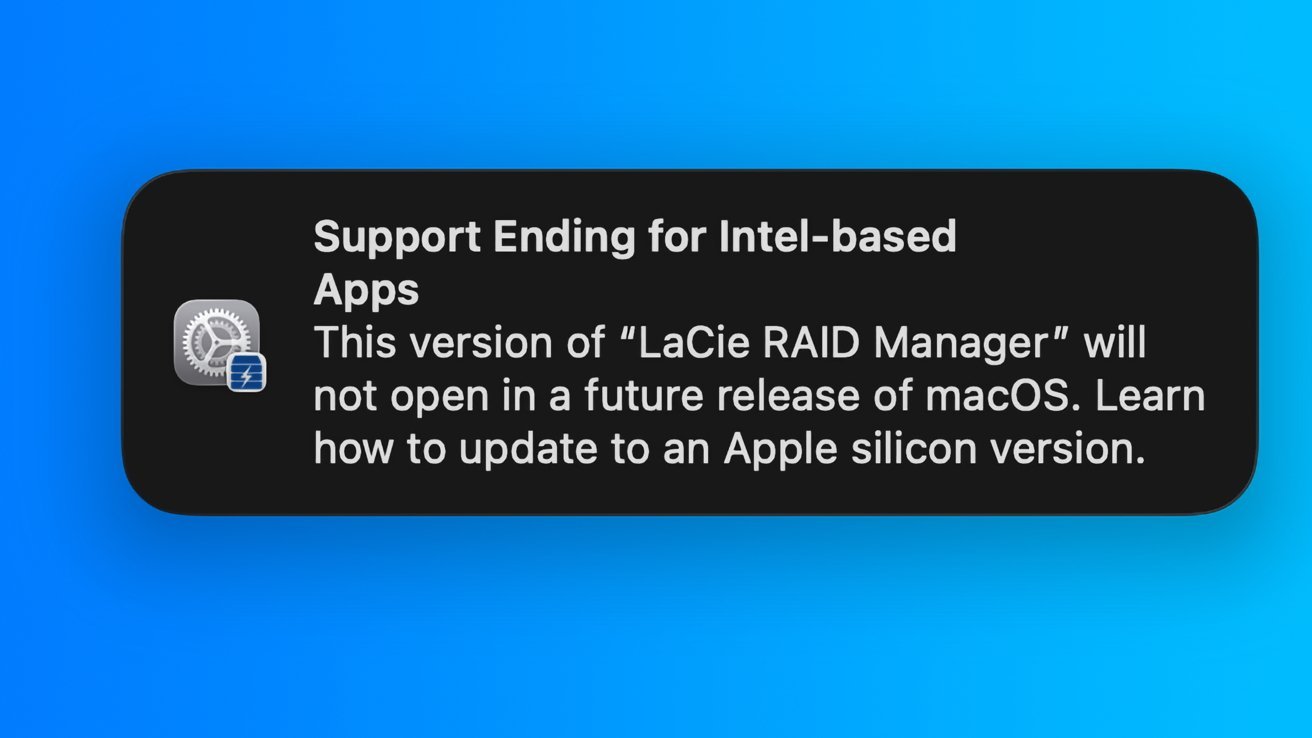
Beta testers of the new macOS Tahoe 26.4 are getting a warning that their favorite Intel-only apps won’t work in macOS 28 because Rosetta 2 is killed.
Rosetta 2 was introduced as a way to allow applications built for Intel chips to continue to run on Apple Silicon. More than five years after its introduction in November 2020, Apple warns users that it is ending.
As part of Monday’s first developer beta of macOS Tahoe 26.4, Apple included a warning telling users that some apps on their Mac will eventually stop working. In cases where users run an application that relies on Rosetta 2, a warning will be displayed that the application will not work when it downloads support for the translation layer.
Currently, macOS 26 Tahoe is the last major version of macOS to include support for Intel Macs, while macOS 27 can only be used on Apple Silicon Macs. However, Rosetta 2 will still be available on Apple Silicon Macs with macOS 27, with support ending a year later with macOS 28.
The warning gives users more than a year to get their software affairs in order and replace their apps with alternatives or updated versions that support Apple Silicon. Developers who already have five years to update their software similarly have about a year and a half to complete the job.
While most support for Rosetta 2 will be retired, it will still be available in a limited mode. It will only serve to support older apps like old games that won’t be updated again.
A typical transition timeline
While some may feel that it’s too soon for Apple to eventually remove Intel support from macOS, it’s actually around the same time frame as other major architecture transitions.
For the transition to PowerPC from 68K, Apple’s first Power Macintosh model shipped in March 1994. Support for 68K applications ended in October 1998, making the transition 4 years and seven months.
The transition from PowerPC to Intel began with the WWDC 2005 announcement, followed by the first Intel Mac launch in January 2006. Rosetta was available until its July 2011 withdrawal in Mac OS X Lion. The full transition took about 5.5 years from the first Intel Mac sales, or six if you count the WWDC address.
Apple Silicon’s announcement at WWDC 2020 and the first shipment of M1 hardware in November of that year puts the transition at five years and eight months. The transition will take seven years to complete before macOS 28 is expected to be available in the fall of 2027.
Apple says that a subset of Rosetta 2 for games that won’t be updated will remain in macOS 28. What that is and how it will be implemented in practice remains to be seen.
Software check
End users interested in their apps and games can check the status by clicking the Apple menu icon at the top left of the screen, then opening About This Mac, then clicking Learn More. In the About window that appears, click System Message, then scroll down to Software and click Applications.
The list of installed applications has a column labeled “Kind” that indicates the type of architecture the application is built for. Apps that are universal or listed as Apple Silicon apps already run without needing Rosetta 2.
Users will also be notified by the system without prompting. Watch out for notifications that your software will become unusable because you will need to replace it soon.
Apps marked Intel are not built to run natively under Apple Silicon and need to be updated or replaced.