

Summary created by Smart Answers AI
In summary:
- Macworld reports that the M5 MacBook Air is expected to launch around March 4, 2026, and will feature Apple’s next-generation M5 chip with a 15-25% faster CPU and 45% improved graphics.
- The fanless design may limit peak performance due to the increased thermal output from the more powerful M5 chip, unlike the fan-cooled MacBook Pro models.
- Expected specs include 16GB of unified memory, a 256GB SSD base configuration, and a similar price to the current M4 models, starting around $999-$1,199.
The MacBook Air M5 is expected to be a major update in Apple’s consumer notebook lineup, primarily focused on the move to next-generation M5 silicon. While the MacBook Pro and iPad Pro already switched to the M5 chip at the end of 2025, the MacBook Air currently remains on the M4 platform.
The new MacBook Air M5 has long been expected to arrive in early 2026, and since Apple will invite some members of the media to “Special Experiences” at various locations on March 4, 2026, it’s possible that the new MacBook Air will appear before or during this “event.”
This article tracks what’s being reported and rumored about the upcoming MacBook Air, and offers a look at Apple’s current lineup.
M5 MacBook Air: Processor and performance expectations
- CPU speed: Incremental CPU speed increase of around 15% to 25% compared to M4.
- Graphic arts: Substantial improvements, Apple claims the M5 GPU architecture can deliver up to 45% more graphics performance than the M4.
- Memory bandwidth: An almost 30% improvement in unified memory bandwidth, reaching 153 GB/s compared to the M4’s 120 GB/s.
- AI capabilities: The M5 chip is being heralded as the “next big leap” for Apple Silicon’s AI performance, specifically designed to power Apple Intelligence features on devices.
The M5 MacBook Air is expected to see an increase in CPU, GPU and AI performance compared to the M4 MacBook Air.
We can get a good idea of what to expect because the M5 chip arrived with the MacBook Pro and iPad Pro in late 2025, and our own review and benchmarking of the M5 MacBook Pro showed consistent gains in both single-core and multi-core processing. In our M5 MacBook Pro review, we found that the M5’s single-core and multi-core results were 14 and 22 percent faster than the M4, respectively.
The M5’s 10-core GPU architecture features a new Neural Accelerator in each core, which Apple claims delivers more than four times the peak GPU processing power of the M4. In our real-world gaming tests using 3DMark Solar Bay Extreme, the M5 maintained around 100 fps, a 50% improvement over the M4’s 70 fps.
At the time of launch, Apple described the M5 as offering a “big leap” in AI performance, with the chip said to deliver up to 3.5 times the AI performance of the previous generation. In practical creative workflows, these improvements translate into tangible time savings. For example, exporting a complex audio project in GarageBand was about 10 seconds faster on the M5 compared to the M4 in our tests.
The M5 also features a new 10-core GPU architecture with a Neural Accelerator in each core, which Apple says means it can deliver “more than 4x the GPU processing power compared to the M4.”
M5 MacBook Air: Specs, Storage, RAM
Foundry
- M5 with 10-core CPU, 8-core GPU, 16GB unified memory, 256GB SSD, Thunderbolt 4
- M5 with 10-core CPU, 10-core GPU, 16GB unified memory, 256GB SSD, Thunderbolt 4
- M5 with 10-core CPU, 10-core GPU, 24GB unified memory, 512GB SSD, Thunderbolt 4
The entry-level MacBook Air’s specs will likely include GPUs with fewer cores, and the mid-range MacBook Air will likely match the entry-level MacBook Pro’s specs but with half the storage.
That’s one spec we’d like to see change: the 256GB SSD is on the small side, however the M5 MacBook Air will likely offer the same basic storage. Rumor has it that the new storage could be faster. Memory options can expand with higher RAM configurations.
All models will start with the 16GB RAM configuration, as it has been since Apple introduced it midway through the M3 cycle (October 2024). There will still be an option to add 32GB of memory. It’s unknown if the 4TB SSD option that’s now available on the M5 MacBook Pro will be available, but we don’t expect it.
For the M4 MacBook Air, Apple has upgraded the built-in camera to a 12MP Center Stage and the ports from Thunderbolt 3 to Thunderbolt 4. We don’t expect any change here, however, in the UK and Europe, Apple has left the power adapter out of the box, so it’s likely that the MacBook Air will do the same at launch.
M5 MacBook Air: Design

Apple introduced Sky Blue as a color option with the M4 MacBook Air.
Eugene Wegmann
The current design for the MacBook Air was introduced in 2022. Since it’s only a few years old, we don’t expect it to change with the release of the M5. The M5 MacBook Air is expected to retain the same thin chassis it’s famous for.
With the M4 MacBook Air, Apple introduced Sky Blue to replace Space Grey, but it’s unlikely we’ll see any new colors this generation.
M5 MacBook Air: Display
Foundry
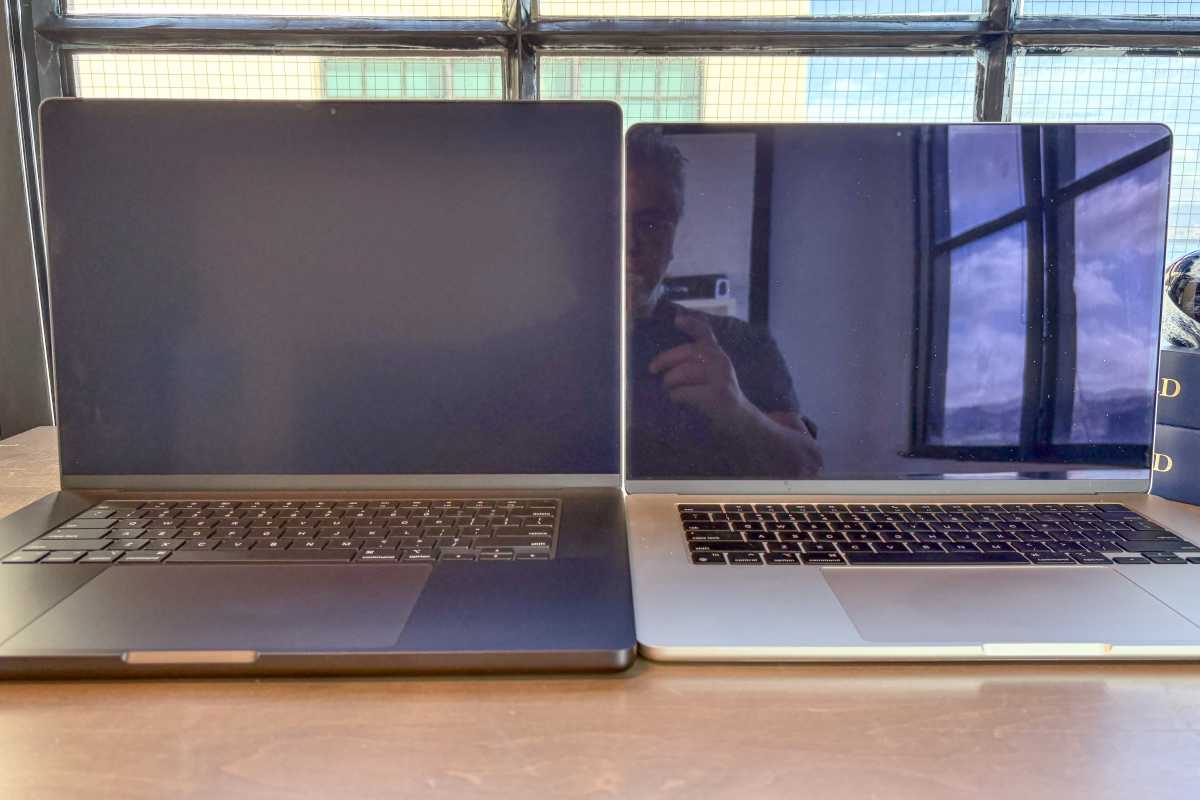
No changes are expected for the M5 MacBook Air display. As before, it will have the standard Liquid Retina display. The ProMotion technology found on the MacBook Pro is expected to arrive on the M5 MacBook Air. It’s also likely that Apple will continue to offer a standard Liquid Retina display to keep the pro lines separate, as with the iPhone and iPad.
Rumors have reported the company’s plans to implement OLED displays in its MacBooks, but this is unlikely to happen until 2027, with the MacBook Pro getting OLED first, possibly before the end of 2026 in the rumored MacBook Pro touch.
M5 MacBook Air: Thermal performance
The increased performance of the M5 chip was found to have an impact on thermal performance – which is likely to impact the MacBook Air due to the lack of a fan for internal cooling.
As noted in the M5 MacBook Pro, it runs faster than the M4 it replaces: “During more intensive tasks like the Cinebench 3D rendering test, the M5 has to throttle its performance to manage its temperature. The fan—both laptops only have one fan—runs much faster on the M5, too.”
If the M5’s peak performance is limited by its single-fan cooling system, the MacBook Air will be limited even more.
M5 MacBook Air: Release date
Apple has confirmed a spring product event (or Experience) on March 4, 2026, and the MacBook Air M5 is expected to launch around that time frame.
The MacBook Air typically follows a different release cycle than the MacBook Pro, usually arriving in the first half of the year after the Pro refresh. Current expectations are for a spring 2026 launch. This timeline is in line with Apple’s established cadence, where the MacBook Pro is often refreshed in November, followed by the MacBook Air in March.
There is likely to be a delay of several months between the launch of the M5 MacBook Pro and the M5 MacBook Air, so we expect to see the M5 MacBook Air in the first half of 2026.
On October 16, Gurman announced that the M5 MacBook Air is scheduled for release in spring 2026.
On February 8, Gurman announced that the M5 MacBook Air was “coming soon”.
And on February 22, Gurman suggested again that the MacBook would be one of “at least five new products” arriving by March 4.
M5 MacBook Air: Price
Most supply chain reports and analysts expect pricing to remain similar to the current M4 Air lineup. Apple could keep the M4 as a cheaper alternative, but rumors suggest the company may be preparing to launch a budget MacBook alongside the MacBook Air, which could mean an increase in the $999 base price. Apple could start the M5 Airs at $1,099 like it did a few years ago.
The threat of tariffs from the US government is also a looming issue that could affect prices.
However, we don’t expect prices to change as MacBook Pro prices have not changed.
Here are the prices for the current standard M4 MacBook Air configurations.
| MacBook Air model | OUR | United Kingdom | Canada | Australia |
|---|---|---|---|---|
| 13 inches, 16 GB RAM, 256 GB SSD | 999 dollars | £999 | $1,399 | $1,699 |
| 13 inches, 16 GB RAM, 512 GB SSD | $1,199 | £1,199 | $1,699 | $1,999 |
| 13 inches, 24 GB RAM, 512 GB SSD | $1,399 | £1,399 | $1,999 | $2,299 |
| 15 inches, 16 GB RAM, 256 GB SSD | $1,199 | £1,199 | $1,699 | $2,099 |
| 15 inches, 16 GB RAM, 512 GB SSD | $1,399 | £1,399 | $1,999 | $2,399 |
| 15 inches, 24 GB RAM, 512 GB SSD | $1,599 | £1,599 | $2,299 | $2,699 |