
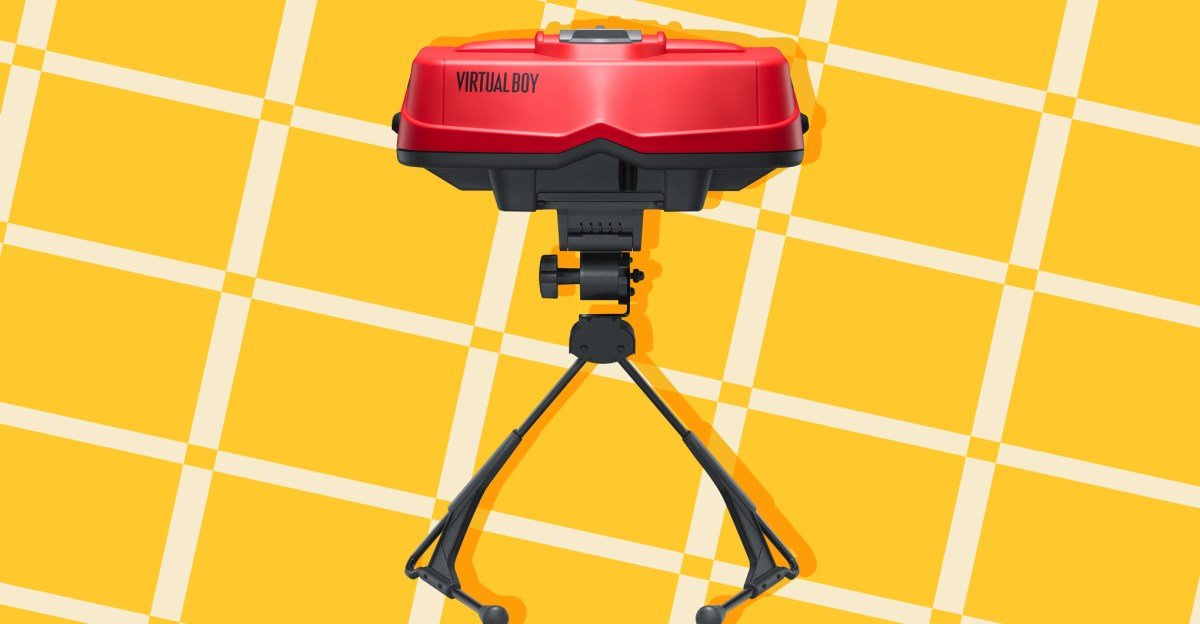
Over the years I’ve written about a lot of different video game hardware, from new consoles to retro gadgets to whatever you want to call Playdate. But I don’t recall ever being forever sore from testing a device; such are the joys of a virtual boy. Nintendo has turned its biggest flop into an accessory for the Switch, but the associated costs — to your wallet, eyes, and neck — make it a tough sell. Like the original, this is a novelty only for Nintendo sickos.
First released in 1995, the original Virtual Boy looked like a VR headset, but it wasn’t actually VR or a headset. Instead, the console offered stereoscopic 3D games that you watched through a pair of bulky glasses that were propped up on a stand. It also rendered games in eye-pleasing reds and blacks, presenting an experience that had some potential but ended up being ugly and uncomfortable. It was a flop and was discontinued after just a year, amassing a library of less than two dozen games.
Now Nintendo has brought the same experience to the Switch. Virtual Boy games have been added to the Nintendo Classics collection of retro games available to Switch Online subscribers this week, but the twist is that due to the unique nature of the original hardware, you have to buy an accessory to actually play them. There’s a plastic remade version of the virtual boy that will set you back $100, which is what I used, as well as a cheaper cardboard headset that’s a much more reasonable $25. In any case, you will need both a subscription and accessories to play these games.
Technically, the games will run in portable mode without an accessory attached, but without magnifiers they are displayed so small that they are essentially unplayable. It looks something like this:
Plastic virtual boy appearance like the original hardware, complete with a fake controller port and volume control. But it’s actually an elaborate Switch (or Switch 2) case that turns it into something reminiscent of a Virtual Boy. Here’s how it works: The top of the Virtual Boy opens up, allowing you to slide the Switch, minus the Joy-Con controllers, inside. When you close it, the Switch becomes a console that powers a Virtual Boy-like experience. Look through the glasses and you’ll be awash in pixelated reds and blacks (though more colors will be available at launch).
Since you’re not wearing it strapped to your face, the Virtual Boy doesn’t have the same issues as a typical VR headset where you’re carrying a lot of weight on your head. But in my experience, it’s still not comfortable. The stand is adjustable so you can change the angle of the glasses, but I had a hard time finding the optimal viewing angle despite trying to play with it in many different ways. And man, those red graphics; they were hard to watch in the 90s and things haven’t gotten much better. Virtual Boy is a system where you need to take frequent breaks to save your eyes and neck. Don’t make the same mistakes I did.
That said, the Virtual Boy line-up is surprisingly interesting to play in 2026. There are seven titles available at launch, though there are a few goofs – I just can’t seem to wrap my head around a first-person robot fighter. Teleroboxer — I really enjoyed playing 3D Tetris, Galactic pinballand a space shooter Red alert. Exceptionality can be Wario Landa fairly straightforward and occasionally clunky platformer, but with 3D elements such as enemies popping out right in front of you to make things feel more tense. It’s not a huge build by any means, but it gives you a good sense of what Virtual Boy is all about. That said, there are some solid games with neat 3D tricks that are fun in short bursts. (Why the tentacle Mario’s tennis not available at launch, especially given the recent release Mario tennis fever, is a mystery to me.)
Nintendo tends to have a complicated relationship with its own history, often overlooking its failures and miscelebrating what makes its games so important. So, on the one hand, the existence of this virtual boy seems like a miracle. Few people had the chance to play the original and here it is available through Nintendo’s most successful platform ever. But it’s also a product that requires jumping through a lot of hoops for little payoff. And since it’s tied to NSO, you’re only spending $100 playing games while you’re subscribed or the service is active. Then you have an expensive paperweight.
The Switch version of Virtual Boy is a device that’s weird, clunky, and has limited appeal — which, now that I think about it, perfectly recreates the experience of the original.