
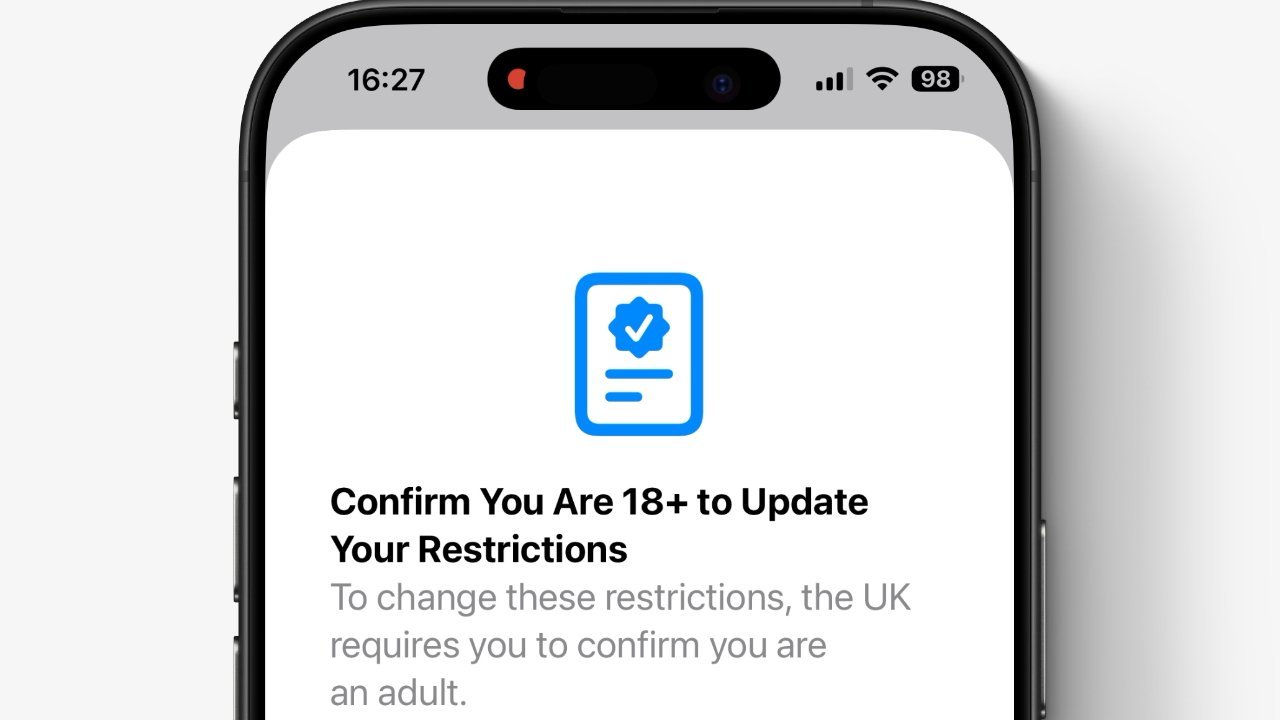
The latest iOS 26.4 developer beta has introduced age verification, though only for the UK so far. You can delay the setup, but the whole process is ridiculously fast.
Among features like improved RCS message encryption, the latest iOS 26.4 beta has added age verification for the first time. It is currently available in beta in the UK as required by the country’s online safety law.
Apple’s implementation is not part of how the UK uses the law to mandate that adult sites verify the age of users. It’s instead another aspect of how parents can already limit their kids to age-appropriate apps on the iPhone.
Eventually, age verification APIs will be exposed to websites, but that hasn’t happened yet.
It’s easy though. After installing the iOS 26.4 update, the first thing you’ll notice is a new section at the top of Settings. It’s labeled “Verify you’re over 18.”
Clicking on that will take you to a new screen that offers the tiniest of extra details.
The entire process can take less than two seconds.
“To update your restrictions, confirm that you are over 18,” it continues. “To change these restrictions, the UK requires you to confirm that you are an adult.”
The small print note says that Apple can verify that you’re an adult by checking any payment method you have with your Apple account. “A valid credit card can help confirm that you are at least 18, as you must be an adult to open a credit card account.”
apart from that there are two more buttons — Continue and Confirm later. There’s no telling how long iOS 26.4 will wait for the prompt if you choose to continue later.
But then there’s no obvious benefit to waiting, no obvious reason, because the rest of the process couldn’t possibly be faster or easier for most. From tapping Continueand after scanning Face ID, verification took less than two seconds.
In our case, the process explained that this verification was limited to “the length of time you’ve had an Apple account.” A likely newer user or a user without a registered credit card in their Apple account will be asked to provide additional details such as a card scan.
Of course, Apple suggests it well
The first requirement of the Online Safety Act was age verification on adult websites. Some of them have since been fined for non-compliance, suggesting that installation is demonstrably difficult.
However, from a user perspective, age verification was nowhere near as simple as Apple’s implementation. The process varies, but may involve a website taking a photo of the user and then, possibly through AI, calculating their approximate age.
All of this, including these first steps from Apple on age-appropriate apps, would seem like a good idea that is implemented with the best of intentions. However, in the UK it was really another example of political posturing instead of genuinely useful security.
There have been reports of people from the UK bypassing verification on these sites by simply showing their camera a photo of someone older. And there are more verified reports that using a VPN to mask the user’s country.
For example, NordVPN reported a 1000% increase in purchases from the UK. Proton VPN saw 1,400% more signups minutes after the law went into effect.
Curiously, analytics firm Sensor Tower reported in July 2025 that far more iPhone users than Android users download VPNs. In the first days after the implementation of the law, the number of Android VPN registrations increased by 5% per day, while the number of iPhone users increased by 100%.
What happens next
Apple’s new age verification will launch in the UK once iOS 26.4 is officially released. Over time, the UK may also require age verification for VPN use.
But that’s also because Apple is a bit ahead of regulators in adding age verification than is required globally. For example, in December 2025, it was reported that the US government wanted age verification to be added to the App Store.
That’s despite Apple announcing in February 2025 a sweeping plan to implement what it called Age Assurance. In addition to working to prevent children from seeing inappropriate content, it also protected them by not allowing developers to access a user’s personal information under the guise of authentication.
Soon after, in March 2025, Utah became the first state to require Apple to perform age verification.
Even so, just next month, April 2025, Meta and Spotify were named in a group protesting that Apple should be responsible for age verification.
Ignoring the fact that the group said this after Apple had already done so, there was also an element of Meta trying to transfer money to Apple. It’s easier to argue that a platform should do this than to pay to implement it into your own services.
Now that iOS 26.4 is shipping to users, at least Apple is implementing at least some age verification on its platform. And with Apple doing it, at least our credit card information isn’t being passed on to countless different third-party companies.