
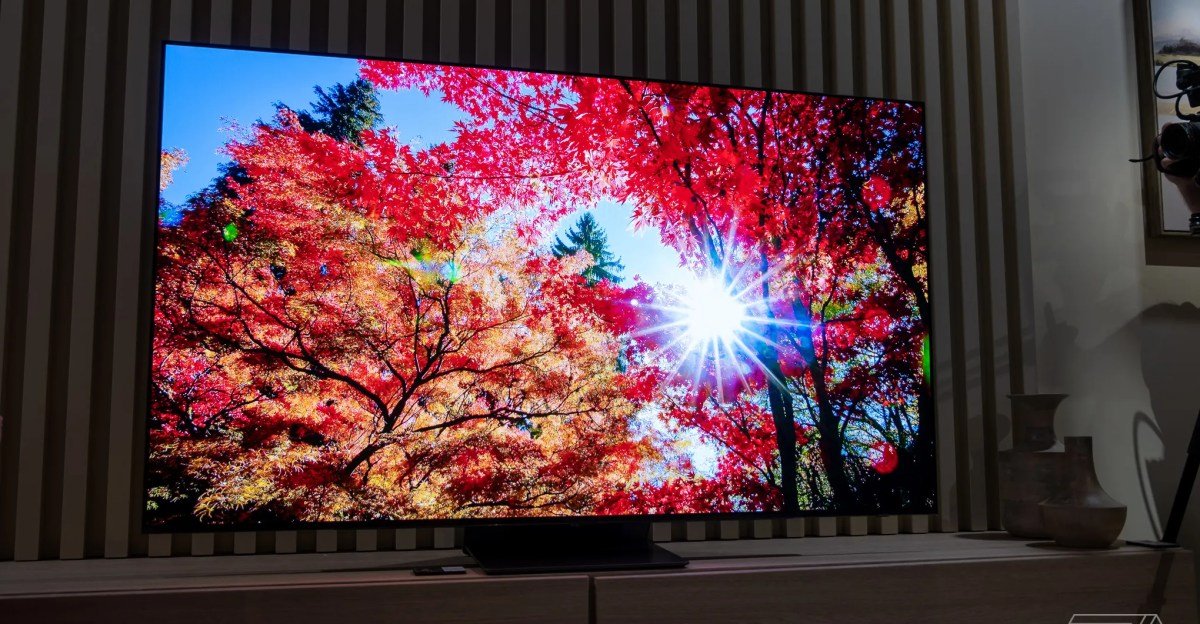
In June 2024, in a dusty TV shop where there weren’t many customers, me, my wife and my kids, I was staring deep into the LG C3 and the Samsung S90C. I went back and forth between the two OLED screens for easily 20 minutes, happily paralyzed by the choice before me. Video Only retailer tried to explain that there was no bad decision.
A year and a half later, I disagree: I regret choosing Samsung over LG. I regret it every time I adjust the volume on my TV, every time I plug in a new device, and especially since the Logitech Harmony Amazon Alexa integration screwed up the bed and I have to fumble with the Samsung remote to switch inputs.
Samsung’s QD-OLED panel itself is phenomenal, if nothing special in 2026. The problem is the software. I would pay Samsung $100 for this “smart” TV to be as dumb as the ones I grew up with.
Hell, I’d give Samsung 50 bucks just to disable the volume indicator. Failing that, we’ll see if the shame works.
Let me be clear: One of the last deciding reasons I chose the Samsung S90C over the LG C3 was that the LG had failed me before. My LG E7 OLED, purchased in 2018 from Fry’s Electronics, not long for this world, eventually developed a large heat spot (not your typical burn-in) that sometimes discolored the image. Before that, my previous Sony TV developed a series of dark pixels shortly after the warranty expired.
But both Sony and LG had subtle on-screen volume indicators, just little icons near the edge of the screen. Samsung believes that anyone who sometimes needs things a little louder or quieter is willing to tolerate this aberration:
This eyesore stretches nearly a third of the screen, both vertically and horizontally, obscuring the incredible moving art I’m trying to watch underneath. And if you’re using a receiver, it will use up all that screen space to transmit basically zero information. Not the current volume level unless you’re using the TV’s built-in speakers, and not whether I’m receiving a stereo or surround signal or a Dolby Atmos signal.
It’s the Samsung equivalent of Microsoft’s Clippy, but worse: “It looks like you’re trying to adjust the volume!”
We watch a lot of movies that contain too much loud action and dialogue too quiet at an hour when the kids are supposed to be in bed, so we’re constantly adjusting the volume.
In 2023, user “1544CT” complained on the Samsung Community Forums that “as someone who watches a lot of movies and shows, I can no longer recommend Samsung until this annoyance is fixed.” But they didn’t seem optimistic. After all, the company has yet to deal with a 26-page harassment thread from 2020 that now has more than 130,000 views.
1/13
There are many Reddit threads and even a Change.org petition to fix this. Although a Samsung moderator promised to deliver the complaint to the company’s engineers, three years and nearly 50,000 more views have passed without resolution. Some users reported that they received the v2203 update which at least reduced the size of the overlay, but it seems that the update may have been put on hold in December due to issues. Will we ever see it?
Problem number two: Samsung doesn’t have the HDMI input concept right, so every time I plug in a new gadget, I’m fumbling with the remote control.
This is how my Samsung TV works in 2026:
- Step 1: Plug the game console into the HDMI port.
- Step 2: Wait for the Samsung TV to automatically detect the game console. And if it doesn’t have good HDMI-CEC, which I’ll explain in a second:
- Step 3: Press the Home button on the remote to display a forest of colorful Smart TV app icons, none of which are my game console.
- Step 4: Press the left button on the D-pad to ignore these icons and bring up the vertical sidebar instead. Press down and then right to bring up another horizontal bar of connected devices. If it’s an unknown like Analogue 3D, I hope it’s the one I marked as “PC” last time.
- Step 5: Set this “PC” to gaming mode the first time by bringing up the basic settings menu, then the advanced settings menu, then go to the gaming mode switch.
- Step 6: Play.
- Step 7: Repeat steps 2-5 each time I disconnect and connect a new device.
I suspect that not everyone always connects new gaming handhelds and analog 3D and mini-SNES via HDMI like I do. But on my LG TV and every HDMI-capable TV I’ve ever owned, I could press a button to cycle through the HDMI inputs until I got the right picture.
Fortunately, my PS5 and Switch 2 have pretty decent implementations of HDMI-CEC, the communication protocol that allows them to send commands to my TV. When the kids want to watch Netflix or light up Astrobotthe power button on the DualSense pad or the 2 Joy-Con switch will do. But strangely, my TV and receiver won’t turn on off.
I used to get around most of this by setting up complicated Logitech Harmony Hub routines that started when I said “Alexa, turn off the TV” or “Alexa, turn on the Nintendo Switch.” But since this Wi-Fi infrared remote stopped syncing properly with Amazon and Logitech servers this year, I’ve had to use Samsung’s software and remote more than ever.

One day I thought of trying Home Assistant when Samsung TV and SmartThings from Samsung appeared in the list of possible integrations. Maybe I could switch the HDMI device from my phone? But even there, Samsung doesn’t expose individual HDMI ports; I could only tell my screen to switch to “TV” or “HDMI”, no other sources or channels.
Those other HDMI sources do there is in Samsung’s API because third-party homebrew integration made my other connected devices like “PlayStation 5” and “AV Receiver” appear in Home Assistant – but only after connecting my TV to the Samsung cloud and generating a custom API key. Yes, I have to reach out to Samsung’s cloud internet and return home to change the HDMI inputs. And it’s still not reliable because Samsung’s cloud sometimes tells me I’ve made too many requests, and sometimes it needs a whole new token before it will accept commands again.
I’m ready to go after the old infrared universal remote at this rate and teach my kids some pointing skills. But hey Samsung, how about $50 for a repair? I have PayPal, Venmo, heck, I’ll put my card number on the TV itself if you’ll let me.
I asked Samsung a few days ago about possible updates, but they didn’t have an answer by the time of publication.